

Strawbale Overview
Straw has been used as a construction material for as long as humans have practiced agriculture.
Early structures implement straw-clay combinations. The straw provides tensile strength and insulation, and the clay glues the loose fibers together. Baled straw was first used in construction in the late 1800's by settlers in Nebraska. The innovation was a product of newly invented baling machines, as well as limited availability of conventional building materials in the prairie Midwest. Strawbales were used to construct many types of buildings, including schools, barns, houses, corer stores, and more. Some 75+ year-old buildings are still inhabited today. And historic strawbale structures can be found in a variety of climates: from hot to cold, and from dry to humid.
strawbale guest house with lime plaster | thick clay plaster covers insulating strawbale walls |
Straw is the stalk of any grain plant: oat, wheat, rice, barley, etc. Straw is high in cellulose, similar to wood, and is therefore not highly nutritious to farm animals. (This is different from hay, which is dry grass, and is grown as food source.) After grain harvest, a small percentage (up to 15%) of the stalks can be tilled back in to the soil to re-supply nitrogen. The remaining stalks, however, are essentially a waste product. Farmers used to burn much of this waste, releasing fine particles and CO2 into the atmosphere...contributing to pollution and climate change. Burning is now widely banned, leaving farmers to search for other uses for straw. When California banned straw burning, grain farmers were instrumental in helping to pass a building code for strawbale construction.
Strawbale wall construction takes 2 forms: loadbearing (or Nebraska style) and infill (non loadbearing walls). Loadbearing construction, as its name implies, uses strawbales as large building bricks that support all of the building loads. Infill construction uses an independent structural system with strawbales filling in between. This overview addresses strawbale infill techniques.
Best Use
Use strawbales to minimize energy for heating or cooling.
Strawbale walls provide very high insulation (R-36 minimum).
Insulation slows the transfer of heat through your walls.
In other words, heat stays inside in winter and outside in summer.
Therefore, strawbale homes require less energy to stay warm (or cool).
Cheat Sheet | STRAWBALE WALLS |
STRAWBALE WALLS
Strawbale walls use large bricks, made from straw fibers, stacked to form a super-insulating wall. Both sides are typically finished with breathable plasters, made from clay or lime. Walls are thick (averaging 16" to 26" depending on bale size & orientation). Techniques are quick to learn and use simple tools. However, attention to details must be followed to ensure walls stay dry (and thus are built durably). | AT A GLANCER-2.7 per inch of thickness meets all fire safety codes meets hurricane wind-load codes can be used in wet/humid climates inexpensive material modest labor to install BEST USEuse as insulation to reduce heating or cooling energy (wherever you plan to use heating or air conditioning systems) LINK TO GLOSSARY |

strawbale walls can be curvy...especially if they are independent of the roof structure 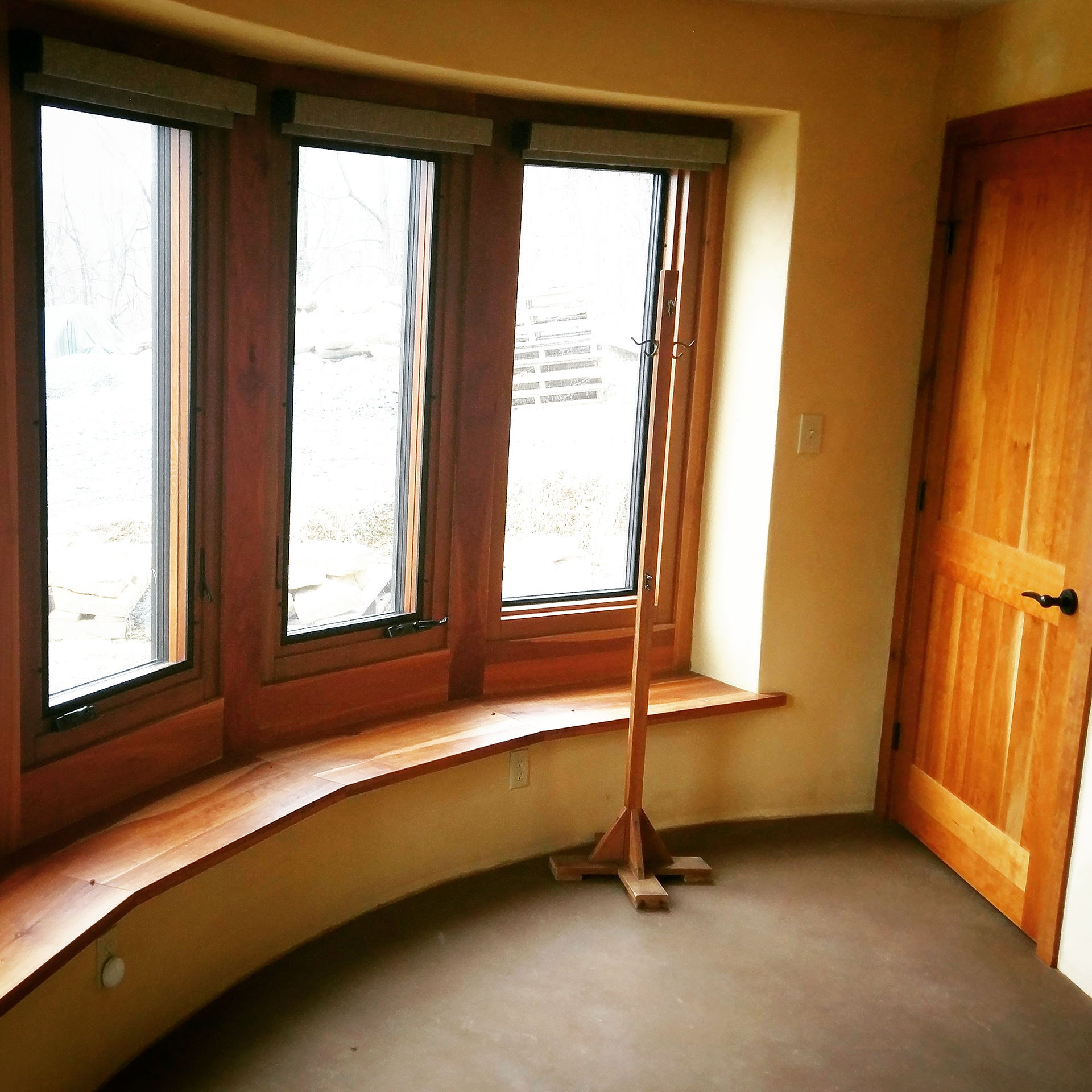
strawbale walls create deep window sills...ideal for extra seating
strawbale walls can be curvy...especially if they are independent of the roof structure | strawbale walls create deep window sills...ideal for extra seating |
Infill Strawbale Walls
Strawbale infill construction does not rely on bales to carry any of the building loads (other than the weight of the bales themselves). The bales infill around any framing, meaning you can use any type of structural system that holds up the floors and roof. Infill construction simplifies the building permit process and can be less intimidating to builders and contractors, because structural elements are conventional.
The basics of strawbale infill construction are simple to learn and require no expensive tools. The skillset required to successfully install strawbales includes: retying bales to a specified length, cutting notches to fit around framing elements, and plastering.
The Process
1. Construct all structural elements (including foundation, walls, floors, roof)
2. Construct window & door framing plus interior walls (non-structural).
3. Dry-in roof and install finish roofing material.
4. Install strawbale walls.
5. Install doors & windows.
6. Rough-in and inspect electrical & plumbing.
7. Apply first coat plaster on interior & exterior.
8. Install all trim.
9. Apply second coat plaster on interior & exterior; shape walls tight to trim
10. Install any drywall; tape & float. Tape is also applied at connections
between plastered walls & drywall, including joint to ceiling.
11. Install any cabinets, countertops.
12. Apply finish plaster to interior & exterior, pigment as desired.
13. Install electrical & plumbing fixtures.
Schedule project-specific elements & inspections as appropriate.
Benefits | Challenges |
|
|
PERFORMANCE
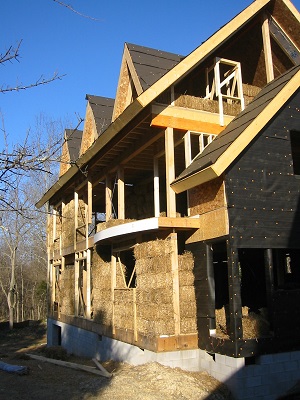
strawbale infill wraps around a structural skeleton 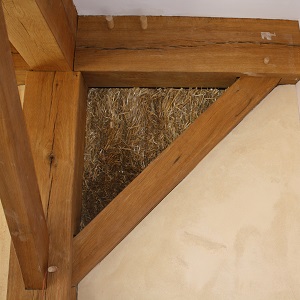
truth window let's you show that yes, really, your walls are made from straw 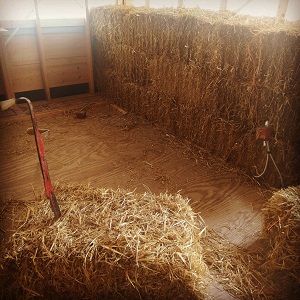
strawbales in the process of wall building 
electrical boxes attach to a wooden wedge 
wiring mounts on the surface, since plaster is over 1.5" thick
SIZEThe size of strawbales depends on the specific dimensions of the baling machine that made them. There are 2 common bale sizes in the USA: 18" wide x 14" tall 24" wide x 18" tall
INSULATIONInsulation is measured in R-value, which quantifies how well a material resists heat flow. The higher the R-value, the greater the insulation.
Third-party testing of strawbales puts the R-value between R-2 and R-2.7 per inch of wall thickness. That means strawbales have the following R-values: 18" bales = R-36 to R-48 24" bales = R-48 to R-64. For reference, model energy building code requires that walls have R-19 insulation, minimum, in most regions of the USA.
Higher insulation means less heat flows through the walls. Strawbale structures, therefore, use substantially less energy to heat and cool than conventionally framed structures.
RELATIVE COSTSMaterials for strawbale wall systems cost less than materials used in conventional construction. (Material costs make up about 1/2 of conventional construction costs, compared to only 1/4 of a natural home.) However, labor costs are substantially higher for a natural building.
This accounts for many owner-built strawbale structures costing a fraction of what the same house would cost using conventional materials.
As a general rule, however, the exact same structure will cost the same whether built conventionally or naturally. (Assuming you pay for all labor costs.) The difference is that a natural building pays more for labor and conventional construction pays more for materials.
The biggest difference, of course, is that costs for energy use over time will be lower (and sometimes zero) for a natural home.
PESTSPest infestations are absolutely not an issue with walls that are monolithic, have no nesting cavities inside, and are finished with thick plasters on both sides. The same is true for bugs...as long as walls remain dry, the inside of a strawbale wall does not have enough food source or moisture to create a suitable habitat for bugs. | FIRE RESISTANCELoose straw is highly flammable. Which leads people to believe that strawbale walls must also be flammable. However, quite the opposite is true.
Fire needs 3 things: fuel, oxygen, and a spark. The difference between loose straw and a tight strawbale, is that there is not enough oxygen inside a strawbale to support a flame. In addition, strawbale walls are finished with thick plasters...the same materials used for fire-proofing.
Testing supports the fire-resistance. Strawbale walls pass a two-hour rating in a small-scale fire test (ASTM-119), outperforming most standard types of construction. Flame spread characteristics and smoke development (ASTM E-84) also exceed code requirements, with a flame spread index of 10 and a smoke development of 350.
MOISTUREBy far, the biggest concern with strawbale walls...as with any construction materials...is moisture. Any material that stays persistently damp can support mold growth. When biodegradable materials remain damp they begin to decompose. This is true for wood as well as straw.
Moisture infiltrates a wall in one of two ways: as liquid water (such as from a leaky pipe or roof) or as vapor/humidity. Preventing liquid water migration requires careful detailing (at wall penetrations and horizontal surfaces). Humidity only becomes a concern if it condenses inside the wall. Which means eliminating cold spots inside the wall (where humidity condenses into a liquid) and using only vapor-permeable finishes that allow humidity to migrate freely through a wall.
Bales should be dry before installation (15% or less moisture) and the tops of all walls must be protected from rain during construction.
INSTALLING ELECTRICALInstalling wiring is actually more simple with strawbale walls than with conventional studs. This is because there is no need to drill studs and snake the wires through. Wires are simply surface mounted to the bales using 4" landscape staples or tucked between the bales. Plaster is a minimum of 1-1/4" thick, which meets the code requirement for wire location behind the wall surface.
Junction boxes are attached to structural elements or are screwed to wooden wedges driven tightly into the monolithic bales. |

light bounces off clay plaster 
small passive solar strawbale cottage with lime plaster 
strawbales wrapped around timber framing
light bounces off clay plaster | small passive solar strawbale cottage with lime plaster | strawbale wrapped around timber framing |
Building Permits
Most habitable buildings in the USA require a building permit. And that's not a bad thing. Building codes ensure that all structures perform at a baseline for safety, durability, and energy efficiency.
Several states and counties throughout the USA have adopted building code amendments for strawbale construction. However, you absolutely can get a permit for strawbale buildings anywhere in the USA. Even if you do not live in a jurisdiction that specifically spells out strawbale methods in their code. This is because strawbale wall systems meet all of the performance requirements for wall systems everywhere in the U.S.
Every building code begins with a paragraph that basically states something to this effect: You may use alternative materials and methods that are not specifically laid out in this code...IF...you demonstrate compliance with the INTENT of the applicable codes. Demonstrating compliance means supplying testing data that explains safety & energy performance. Luckily, testing data is available for free online, thanks to the generosity of many strawbale pioneers in the 1990's.
How to communicate with permit officials
The most important thing to keep in mind when getting a building permit is that the people working in the permit office are there to collaborate with you.
1. Educate yourself well on what and how you want to build. The permit officials will need to feel comfortable entrusting you with this non-standard construction method. If you do not feel confident with your knowledge, hire a professional that is acquainted with strawbale construction to assist you.
2. Start an early dialog with your building officials. You can start with a phone call, but often face-to-face meeting is most effective. Be friendly and have a collaborative (not combative) attitude. If they are not already familiar with strawbale construction, provide them with printed information and additional resources. Do not overload them! If they ask you something you don't know, tell them so, and offer to provide additional information.
3. Give them time to review the information you provided...at least a week. Then follow up and ask if they have any additional questions or concerns. Ideally ask them to itemize any concerns in writing.
4. Address each concern in a clear, concise, and informed manner, and submit your response in writing. Again, get professional assistance if you are not confident with your knowledge.
Recommended Reads
Here are my favorite books about strawbale construction
(click the cover of the book to purchase)

If you are looking for one book on strawbale construction, this is the most comprehensive choice. 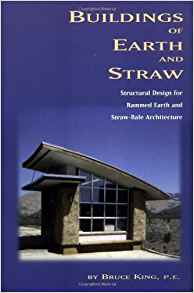
This book is written by an engineer FOR engineers. 
This book combines technical info with clear process photos and practical details. 
A short book with lots of photos that shows the diversity & beauty achievable with strawbales 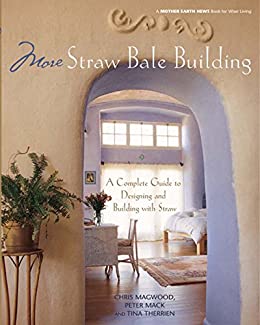
A great practical guide to strawbale construction, from design & permitting basics to details for co
Serious Straw Bale: If you are looking for one book on strawbale construction, this is the most comprehensive choice, especially for wet climates. | Buildings of Earth and Straw: This book is written by an engineer FOR engineers. I give this book to my structural engineers so they understand how to detail natural buildings. | Building with Straw Bales: This book combines technical info with clear process photos and practical details. Useful for DIY-ers & designers alike. | The Beauty of Straw Bale Homes: A short book with lots of photos that shows the diversity and beauty achievable with strawbales and natural finishes. | More Straw Bale Building: A great practical guide to strawbale construction, from design & permitting basics to details for construction and finishing. |


I appreciate having different Sports Games at Freewebgames.io available in one place instead of searching across multiple websites. One day I might feel like playing basketball, and the next I might want to race against the clock or try a baseball challenge. Having several options makes it easier to find something that matches my mood.